Rule changes when playing at yucata.de
If you can't move and need to exchange cards, you must show your hand cards to your opponent. This is intended to prevent that a player overlooks a legal move or even tries cheating. On yucata.de the system checks for legal moves, thus it is not necessary to show your hand cards to your opponent when exchanging cards.
According to the original rules, cubes are taken blindly from the bag and distributed on the mats. This leads regularly to a lock-up of the game. E.g. there are five gray cubes and five gray cards in the game. If the grey cubes are all at the same time on the mats and the cards are distributed to all mats, it is not possible to finish the mats any more: the game is blocked. The implemented algorithm ensures that there are always less cubes of a colour in the game than which are needed to claim a cup. I.e. never more than two gray, three blue and so on.
Overview
In Balloon Cup, the players compete in several short balloon
flights (hops) to collect the colored cubes associated with
each hop.
When a player has collected enough cubes of a
given color, he earns the trophy card for that color. Players
may even trade 3 otherwise useless cubes for 1 they can use.
The first player to earn 3 trophy cards is the winner!
Each player has a hand of eight balloon cards. The players
play their balloons on mountain or plain hops. Players play
their high-valued balloons on the mountains and their low-
valued balloons on the plains. Players usually play their
balloons on their side of the hops, but winds (and cunning)
can cause them to play on their opponent's side, a move that
can ruin their opponent's plans.
Goal
Players place their balloon cards next to the balloon hop tiles, trying to
collect victory cubes in the right colors so they can claim trophy cards. The
first player to take 3 of the 5 trophy cards is the winner!
Preparation
the hop tiles:
-
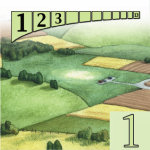
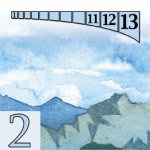
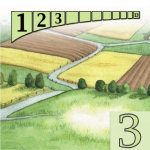
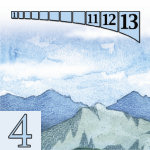
Place the 4 balloon hop tiles in a row between the two
players as shown to the right:
-
Place the 45 victory cubes in the bag and mix them.
-
Place victory cubes on the balloon hop tiles. Randomly draw victory cubes
from the bag and place them on the ballon hop tiles: 1 on tile number 1,
2 on tile number 2, 3 on tile number 3, and 4 on tile number 4.
-
Shuffle the balloon cards face down and deal eight cards to each player.
Each player takes his cards into his hand, keeping them secret from his
opponent during the game.
-
Place the remaining balloon cards face down as a supply next to the
board. A discard stack will form next to it. If, during the game, the supply
is exhausted, shuffle the discard stack and place it face down as the new
supply.
-
Place the 5 trophy cards face up near the board.
The players decide who will start. The players then alternate turns.
Playing the game
WOn a player's turn, he selects a card from his hand and places it face
up next to the balloon hop tile of his choice.
He may place the card
on his side of the tile or on his opponent's side of the tile.
Then, he
draws the top-most card from the supply and adds it to his hand,
ending his turn.
Placing cards
-
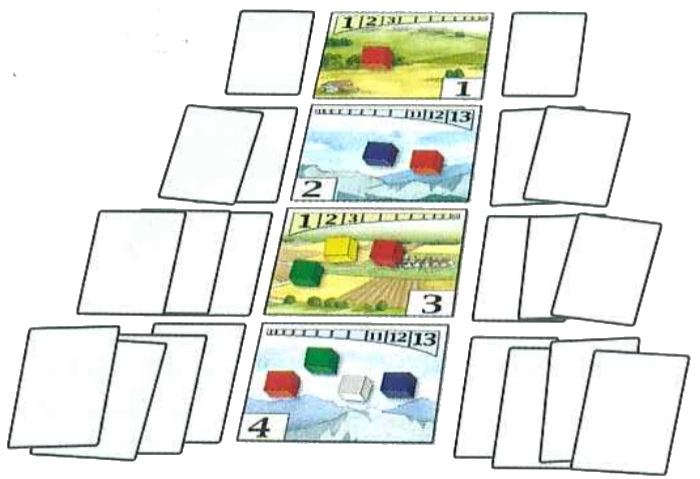
1 victory cubes:
1 balloon card on right and
1 balloon card on left.
2 victory cubes:
2 balloon cards on right and
2 balloon cards on left.
3 victory cubes:
3 balloon cards on right and
3 balloon cards on left.
4 victory cubes:
4 balloon cards on
right and 4 balloon
cards on left.
The number of victory cubes on a balloon hop tile determines the
number of balloon cards that must be placed on each side of the tile.
-
The colors of the victory cubes on a balloon hop tile determine the colors
of the balloon cards that must be placed on each side of the tile.
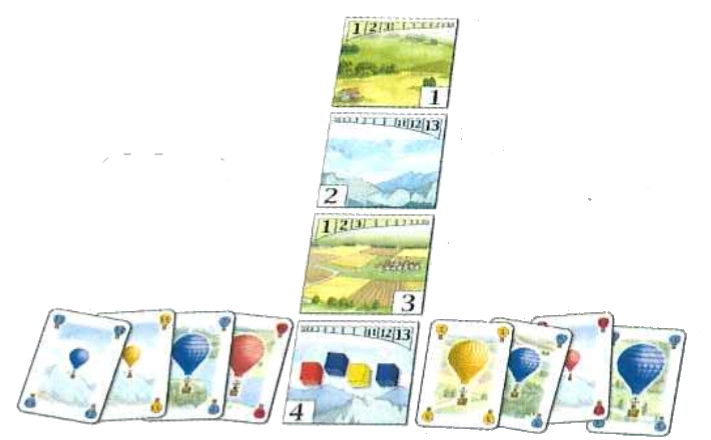
Example: there are 2 blue, 1 yellow, and 1 red victory cubes on balloon hop
tile number 4. Thus, the players must place 2 blue, 1 yellow, and 1 red balloon
cards on each side of the tile.
-
The players place the cards so that they overlap, but do not cover cards
previously placed. Thus, all placed cards can be seen.
-
If the only card a player can place will help his opponent, he must place
it. A player may not choose to place no card on his turn.
-
If a player cannot place any of his 8 cards, he shows them to his opponent
to prove he cannot place a card. If he can place a card, he must. If not, he
may discard up to 4 cards (choose how many first) and draw the same
number from the supply. If he now can place a card, he does. If not, he
again shows his cards to his opponent to prove this. If he can place a card,
he must. If not, he ends his turn without placing a card.
Scoring
When the required number of cards have been placed on both sides of a
balloon hop tile, the tile is scored and the victory cubes given to the winner.
Example: the number 2 balloon hop tile has 2 cards of the required colors
on each side, so it is immediately scored.
-
The winner of this scoring is determined by whether the destination board depicts plains or mountains:
-
If the tile being scored is a mountain, the player with the highest sum
of balloon cards on his side of the tile takes the victory cubes there.
-
If the tile being scored is a flatland, the player with the lowest sum
of balloon cards on his side of the tile takes the victory cubes there.
-
If the sums of the balloon cards on both sides of the tile is the same, the
player who placed the last card wins and takes the victory cubes there. It
matters not on which side the last card is placed nor whether the tile is
mountain or flatland.
-
The winner takes the victory cubes on the tile and puts them in his play
area.
-
The winner discards all balloon cards from both sides of the tile.
-
The winner turns the tile over. Thus, mountain becomes flatland or
flatland becomes mountain.
-
The winner draws as many victory cubes from the bag (without looking)
as the number on the tile and places them on the tile.
-
Now the players check to see if the winner has enough victory cubes to
take one or more of the trophy cards. If so, he takes the card(s) he can.
(see "The trophy cards").
-
The game now continues with the player who lost the tile scoring.
The trophy cards


After scoring a balloon hop tile, the players check to see if the winner has the
required number of victory cubes in one or more colors.
| Colour |
gray  |
blue  |
green  |
yellow  |
red  |
| number of victory cubes |
3 victory cubes |
4 victory cubes |
5 victory cubes |
6 victory cubes |
7 victory cubes |
When a player has the required number of victory cubes of a color (or
more), he puts the required number of cubes back in the box, takes the
trophy card of that color, and places it face up in his play area. Once taken,
a player cannot lose a trophy card during the game.
The players keep any extra victory cubes in this color and can continue to
win victory cubes in this color during the rest of the game.
When a player
claims a trophy card, he can use 3 victory cubes in the color of an already
claimed trophy card, as one victory cube in the color of the trophy card he
is claiming. The player does not actually get the new cube as the trade occurs
when the player has sufficient cubes, including 3 for 1 traded cubes to claim
a trophy card. The cubes used in a 3 for 1 trade must all be the same color.
He may trade more than one set of 3 cubes to claim a trophy card.
Example: the yellow trophy card has been taken. Kevin has 4 green victory
cubes and 3 yellow victory cubes. He puts all 7 of them in the box to claim
the green trophy card.
After the player who won the tile has claimed any trophy cards he can,
including using 3 for 1 trades, the other player may claim one trophy card
if he can, using 3 to 1 trades to do so. Since the use of 3 for 1 trades can have
a cascading effect, the player who won the tile takes precedence in claiming
trophies. Thus, the player who won the tile can again claim as many trophies
as he can after his opponent has claimed one, and so on.
Example: Mike has already claimed the red trophy card and has 2 gray, 3
blue, 3 green, and 5 yellow cubes. Kevin wins a tile, giving him 3 yellow, 3
red, 5 green, 3 blue, and 2 gray cubes. He claims the green and blue trophies,
using 3 red cubes as a blue cube. Mike may now claim the gray trophy using
3 blue cubes as 1 gray cube. As Kevin can claim no trophy, Mike claims the
yellow trophy using 3 green cubes as 1 yellow cube, winning the game! Had
Mike chosen to claim the yellow trophy first, Kevin would have been able to
win the game by claiming the gray trophy before Mike using his 3 yellow
cubes as 1 gray cube.
Note: a player is not obligated to use the 3 for 1 trade when he first can. He
may wait for a time that is best for him, but if he waits too long, he may give
his opponent the chance to make a similar trade for a trophy card.
Not enough victory cubes in the bag
Near the end of the game, it can happen that there are not enough victory
cubes in the bag for a player to fill a balloon hop tile. If this happens, the
player removes the balloon hop tile from the game and play continues with
fewer tiles.
Game end
The game ends immediately when a player takes a third trophy card.
This player is the winner!